
Blog
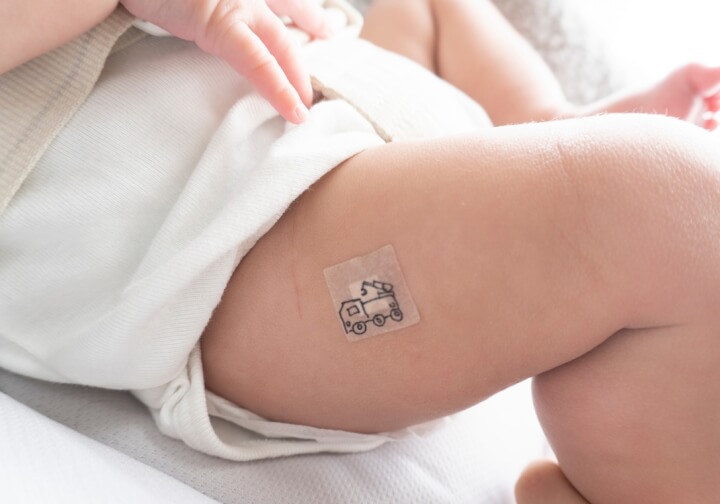
When are a baby’s first vaccinations administered?
Vaccination is one of the fundamental preventive measures in childhood, and in the Czech Republic, it follows a strictly defined vaccination schedule. This schedule specifies when a child should receive each vaccine to ensure the highest possible protection against serious infectious diseases and life-threatening complications.
For parents, the start of the vaccination process can be a bit confusing, so let’s go through it step by step to explain when a baby’s first doses are scheduled and what they entail.
Sometimes it starts as early as the first weeks of life
If a parent or household member has had tuberculosis, or if the parents have spent an extended period in a country with a high incidence of tuberculosis, the first vaccination may occur very soon after birth. Currently, only children at risk are vaccinated against tuberculosis (according to Annex No. 2 to Decree No. 537/2006 Coll.: Indications for Tuberculosis Vaccination), typically between the 4th day and the 6th week of life.
For most healthy children, however, the first standard vaccination comes a little later. It is important to know that if a child is not in a high-risk group, no vaccinations are usually administered in the maternity hospital, and parents have time to prepare for them.
First major vaccinations: 2nd to 3rd month of life
A key milestone occurs around the 9th week of age (i.e., roughly in the 2nd to 3rd month of life). This is when the so-called routine vaccination schedule begins.
During this period, the following is administered:
-
hexavalent vaccine (combined vaccination against 6 diseases):
-
diphtheria
-
tetanus
-
pertussis
-
polio
-
Haemophilus influenzae type B
-
hepatitis B
This vaccine is the cornerstone of childhood immunization because it protects against diseases that can be very dangerous for infants and are also highly contagious.
Vaccination schedule in the first year
The first dose is followed by additional doses of the hexavalent vaccine at relatively short intervals. The goal is to generate a sufficient immune response to ensure the baby is maximally protected.
Typical schedule for administering the hexavalent vaccine:
-
1st dose: around 9 weeks of age (or from 13 weeks of age after recovery from a post-vaccination reaction in the case of children vaccinated against tuberculosis)
-
2nd dose: within 2 months of the 1st dose
-
3rd dose: between 11 and 13 months of age
-
Booster dose: required only for premature infants, 6 months after the 3rd dose
This schedule is called “2+1” (two primary doses + a booster dose).
Voluntary vaccination against pneumococci and meningococci may also be administered concurrently with this vaccination, based on the parents’ decision and the pediatrician’s recommendation. Vaccination against pneumococci can be administered starting at 2 months of age, and against meningococcal group B starting at 12 months of age.
Vaccination against meningococcal groups A, C, W, and Y can be administered between 1 and 2 years of age. These vaccinations are also given in multiple doses, so it is important to keep track of the follow-up vaccination dates set by the doctor.
Additional mandatory vaccinations in toddlerhood
After the first year of life, the vaccination schedule continues with a combined vaccine against measles, rubella, and mumps, administered around 15 months of age, no later than 18 months. This concludes the vaccination series for early childhood.
Further vaccinations and boosters continue starting at age 5. There is also an optional vaccination option that includes a vaccine against chickenpox.
How are vaccinations administered?
Vaccinations are administered by a pediatrician. However, it is not just a simple injection but part of broader preventive care.
Before vaccination, the doctor:
-
checks the child’s health,
-
takes their temperature,
-
asks about any symptoms.
After vaccination:
-
the child may be irritable for a short time,
-
a fever or fatigue may occur,
-
these reactions usually subside within 1–2 days.
When vaccination is postponed
Not every baby can be vaccinated exactly according to schedule. There are situations when the doctor will postpone vaccination.
For example:
-
in case of an acute illness (fever, infection),
-
in certain neurological or immunological conditions,
-
in case of a severe reaction to a previous dose.
The vaccination schedule is therefore a guideline and is tailored to the specific child.
A baby’s first vaccinations in the Czech Republic usually begin around the 2nd to 3rd month of life, when the first dose of the hexavalent vaccine is administered. An exception is the tuberculosis vaccine, which is only given to at-risk newborns. In the following months, a series of additional doses is administered to protect against serious infections.
Parents must know that vaccinations are administered under the supervision of a pediatrician and that the schedule can be adjusted if necessary. If you are unsure, there is always a simple rule: consult your pediatrician, who knows your child’s health best.
Sources:
Vyhláška č. 537/2006 Sb. Vyhláška o očkování proti infekčním nemocem (2022). (Cit. 28.3.2026). Published on: https://www.zakonyprolidi.cz/cs/2006-537
(2022). (Cit. 28.3.2026). Published on: https://szu.gov.cz/temata-zdravi-a-bezpecnosti/vakciny-a-ockovani/ockovaci-kalendar-v-cr-pro-deti-a-pro-dospele/
Očkovací kalendář. (Cit. 28.3.2026). Published on: https://www.jaknamiminka.cz/ockovaci-kalendar/
Očkování – dětský očkovací kalendář. (Cit. 28.3.2026). Published on: https://www.naseporodnice.cz/zdravi/ockovani-detsky-ockovaci-kalendar.php