
Blog
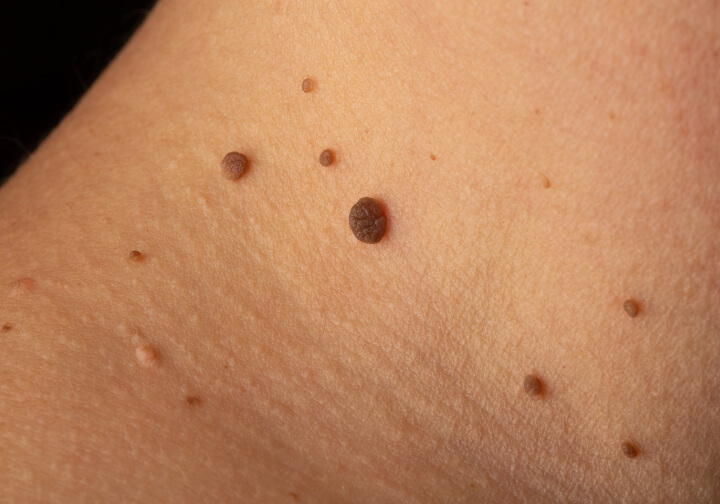
How to remove skin growths
Skin growths bother many people, and although they are often not dangerous to health, they can be unsightly, snag on clothing, and make many people feel uncomfortable. Many people try home remedies first, while others go straight to a dermatologist. To understand how to safely and effectively remove skin growths, it is first necessary to clarify what skin growths actually are, when home care is sufficient, and when it is necessary to seek professional removal.
What are skin growths?
Skin growths is a collective term for a wide variety of formations that can appear on the surface of the skin. In most cases, they are benign, but their origin and manifestations vary.
The most common types of skin growths
Fibromas ("hanging moles")
-
They are soft, stalked, and skin-colored.
-
They do not hurt, but they can be mechanically obstructive (for example, in the groin, armpits, or neck).
-
Fibromas are very common, often occurring in overweight people or during hormonal changes.
Seborrheic keratoses ("age spots")
-
These formations are brown to black, rough to the touch, and appear to be "stuck" to the skin.
-
The occurrence of seborrheic keratoses is mainly genetically influenced, but they appear more frequently with advancing age.
Warts caused by viruses
-
Warts are caused by HPV infection. There are many types, the most common being classic warts,
-
Warts typically occur on the hands, feet, and around the nails, but can also appear on other parts of the body.
-
They can be painful and spread further.
Moles (nevi)
-
Nevi can be flat or raised,
-
Their removal always requires the care of a dermatologist.
-
Any change in the color or shape of a mole requires examination.
Other growths
There are many other types of skin growths. These include molluscum contagiosum, lipomas, small cysts, blood hemangiomas, etc. However, each type of growth requires a different approach.
If you are unsure exactly what type of growth you have on your skin, the first step is always the same: do not scratch, cut, or attempt to remove the growth with sharp instruments. It is better to visit your general practitioner or make an appointment with a specialist dermatologist.
How to get rid of skin growths using folk remedies?
Home remedies can sometimes be effective (especially for viral warts), but safety precautions must be followed.
What you can try for harmless growths
Apple cider vinegar
-
is mainly used for viral warts,
-
has a mildly corrosive effect,
-
is applied carefully with a cotton swab,
-
and takes weeks to work.
-
It can´t be used to remove moles or pigmented lesions!
Tea tree oil
-
has antiviral properties,
-
suitable only for viral warts,
-
applied several times a day, long-term.
Onion or garlic
-
a traditional method with a mild antiviral effect,
-
may irritate the skin.
Adhesive tape method (for warts and corns)
-
cover the wart with tape for several days,
-
then the skin softens and the top layers can be gradually removed,
-
effectiveness varies, but the method is more or less harmless, however, there is a risk of spreading warts to other areas, so it is more than advisable to use sufficient disinfection.
What home remedies for skin growths MUST NOT be used for
-
Pigmented moles.
-
Fast-growing or bleeding growths.
-
Anything with an irregular shape or multiple colours.
-
Growths on the face or around the eyes.
These situations require a visit to a dermatologist. Home remedies can complicate diagnosis, cause infection, or delay the detection of melanoma.
What happens during a visit to the dermatologist?
Removing skin growths is a common, quick, and usually painless procedure that can significantly improve your comfort. The dermatologist will first determine whether the growth is risky and which method is most suitable for its removal. In women, genital warts can also be treated by a gynecologist, and in men by a urologist.
What a dermatologist usually does:
Assessment of the growth
-
dermatoscopy (magnification + light),
-
evaluation of color, borders, structure.
Recommendation of procedure
-
whether a biopsy is necessary and which method is most appropriate.
Removal of skin growths
Most commonly used:
-
cryotherapy (freezing with liquid nitrogen) for warts and keratoses,
-
laser for unsightly fibromas and small growths,
-
electrocoagulation to burn off small fibromas and growths,
-
surgical removal with an instrument, among other things, when tissue needs to be sent for histology.
Treatment and recommendations for healing
-
antiseptic ointment, covering,
-
limiting exposure to the sun,
-
check-ups as needed.
How long does the dermatological procedure itself take?
It is usually done in a few minutes; removing small fibromas takes only a few seconds with the right instrument. Healing then takes 3 to 10 days, depending on the method used and the location.
When to see a dermatologist without delay
-
the growth changes color, shape, or size,
-
it starts to bleed or itch,
-
several new growths appear at once,
-
home treatment does not help,
-
you have doubts about whether it is a skin tumor.
Skin growths are common and harmless in most cases. Some can be treated at home, especially viral warts, but anything pigmented, fast-growing, or aesthetically sensitive should be treated by a dermatologist. Professional removal is quick, modern, and safe, so there is no need to worry.
Sources:
Kdy a jaké kožní výrůstky odstranit. Published on: https://www.estetikachaloupkova.cz/kdy-a-jake-kozni-vyrustky-odstranit/
Jánn Džunda (2022). Papilomy: Co způsobuje výrůstky na kůži a jak se jich zbavit? Published on: https://www.bellmedi.cz/papilomy-co-zpusobuje-vyrustky-na-kuzi-a-jak-se-jich-zbavit/
Daniel Borník (2017). Jak na kožní výrůstky (acrochordony)? Jak je odstranit doma? Published on: https://www.rehabilitace.info/zdravotni/jak-na-kozni-vyrustky-acrochordony-jak-je-odstranit-doma/
Mgr. Lukáš Novotný (2024). Papilomy – příčiny a léčba. Published on: https://www.drmax.cz/clanky/papilomy-priciny-a-lecba
MUDr. Iva Obstová (2017). Kožní choroby způsobené papilomaviry. Published on: https://www.dermatologiepropraxi.cz/pdfs/der/2017/01/04.pdf
Opening hours
Dear clients,
we would like to announce a that Unicare clinic is closed during national holidays, such as 28th of September 2026.
Thank you for understanding!
Unicare Medical Team